


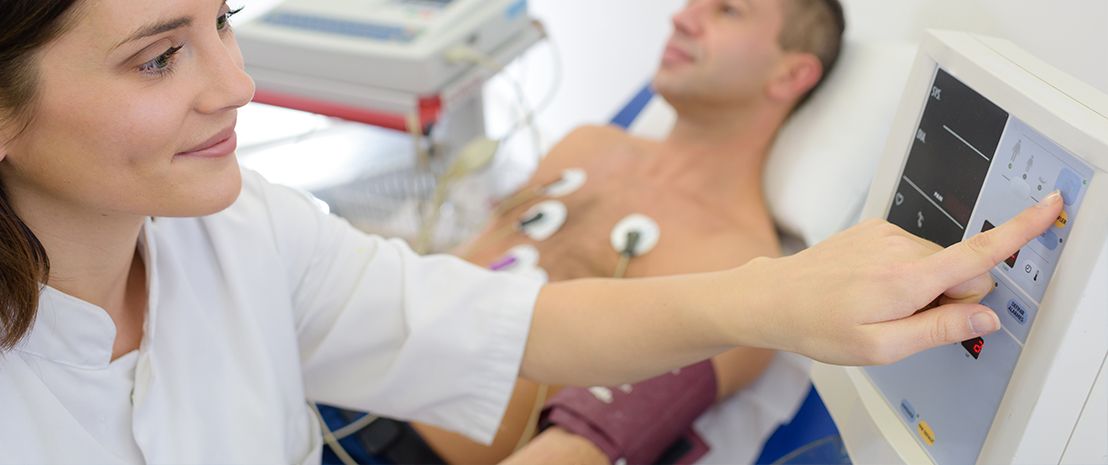
Because the new techniques of cardiac ultrasounds, such as stress echo etc., are a window to the future…
We now have the illusion that we can deal with anything. Today, it is no longer considered absurd that a patient should be unjustly lost because he was not properly treated and diagnosed. We thus see more and more patients with serious problems of Coronary Artery Disease and Heart Failure surviving for more years…Between seriousness and joking, cardiologists say to each other that we are the main cause of the country’s insurance problem since with the development of cardiology the average survival.
Lately there has been a lot of talk about the so-called “New Cardiac Ultrasound Techniques”. As you may have heard, these are promising technological developments in the imaging of the heart using ultrasound, which with their application bring a change in the way of thinking in the modern diagnosis and treatment of cardiac diseases. New techniques include dynamic ultrasound or stess echo, tissue Doppler, transesophageal echocardiography, myocardial deformation and contrast echocardiography.
An ultrasound is a machine, which many of you will have heard of, that uses ultrasound to image the moving heart and its structures with clarity and detail, without a bloody procedure or the use of radiation. With the classic ultrasound, until today we could see the functionality of the heart, i.e. if someone has Heart Failure. We could also see the structural abnormalities of the heart, the valves and study the velocity of the blood. What we could not diagnose was the possibility of hidden Coronary Artery Disease.
Coronary Artery Disease is caused by atheromatous plaques that develop in the heart’s blood supply network, called the Coronary Artery, which includes all the vessels that supply blood to the walls of the heart itself. If a narrowing develops in a vessel of the coronary network, then it will be difficult for the blood to pass easily through this point and thus we say that conditions of ischemia are created, that is because the blood does not pass with the same speed in the sections after the narrowing, these sections they are not properly blooded and this produces various electromechanical changes, which we try to detect early in order to diagnose coronary artery disease in time.
Until today we tried to do this with the Fatigue Test, the well-known Fatigue Test. In other words, we subjected the examinee to exercise, increasing the heart rate and monitoring his electrocardiogram. If ischemia developed, i.e. there was some narrowing in a vessel of the heart, then ischemic changes would be produced in the examinee’s electrocardiogram with which we were able to diagnose Coronary Artery Disease early. But what we saw over time was that the Fatigue Test was only useful in about 67% of patients. In other words, there was a large percentage of patients, about 30-35% with hidden ischemia, who could have a problem and not show up in the Fatigue Test, so we would lose these patients, even though we had followed them closely.
Our effort to diagnose Coronary Artery Disease faster and more validly brought to the surface a multitude of efforts and studies, using alternative methods, with the aim of showing earlier ECG changes created by ischemia. This is how Scintigraphy, Magnetic Tomography and, in recent years, Dynamic Ultrasound or Stress Echo were developed. With dynamic ultrasound instead of electrocardiographic changes we try to detect motility deficits. In other words, we monitor the movement of the walls of the heart during the induction of special stress with an increase in the frequency, that is, of the heartbeat, as if we were exercising. How is this possible? By administering a small amount of a special drug, we make the heart work faster, so that we create a small stress on the heart and its oxygen needs increase, that is, more blood is required to bleed. If there is a narrowing in an artery and the blood does not pass through it well, then there will be a problem in the movement of that part of the heart, which we will see on the ultrasound, as a result of which we can diagnose Coronary Artery Disease in time, without waiting or having the doubt whether or not the examinee’s ECG will change. It has therefore been found that with this method we can safely diagnose up to 90% of patients with Coronary Artery Disease.
The important advantages of the method also include no need to administer radioactive materials, as is done with scintigraphy, no need to be placed in a closed chamber, as is done with the magnet (it has been found that 30% of patients cannot undergo MRI due to claustrophobic feeling), the speed and low cost of the method. Of course, this does not mean that the other assessment methods are less useful since dynamic ultrasound also has disadvantages such as the difficulty of assessment in some, especially overweight patients, as well as the subjective assessment of the results, but that in our arsenal there is now another powerful and reliable method of early diagnosis of Coronary Artery Disease. Your doctor will determine exactly which method is right for you and how you will benefit best from it.
Other applications of modern ultrasound are tissue Doppler, with which we better study the movement of tissues, strain and strain rate, with which myocardial deformation and movement of the myocardium are studied, contrast echocardiography with which, with the use of contrast agents, we can to better image the inside of the heart chambers and the transesophageal ultrasound, which by using a tube similar to a gastroscope gives us clear images in various conditions through the esophagus where the most careful assessment is needed to make decisions that may or may not lead to cardiac surgery. We must note here, however, that the new techniques can only be performed by specialized cardiologists, who have been trained in special specialization centers.
The current decade has been jokingly called the decade of imaging in the world of cardiologists. Now a new window has opened in the most timely and modern diagnosis and treatment of cardiac diseases. Much of what we have achieved today was once a midsummer night’s dream. It is certain that the future is bright. Let us hope that we will also enter this new era morally armored, facing the new challenges with prudence and balance, so that those of us who practice medicine can be truly useful to our fellow man.